

Aircraft / Learjet 55/60 Series
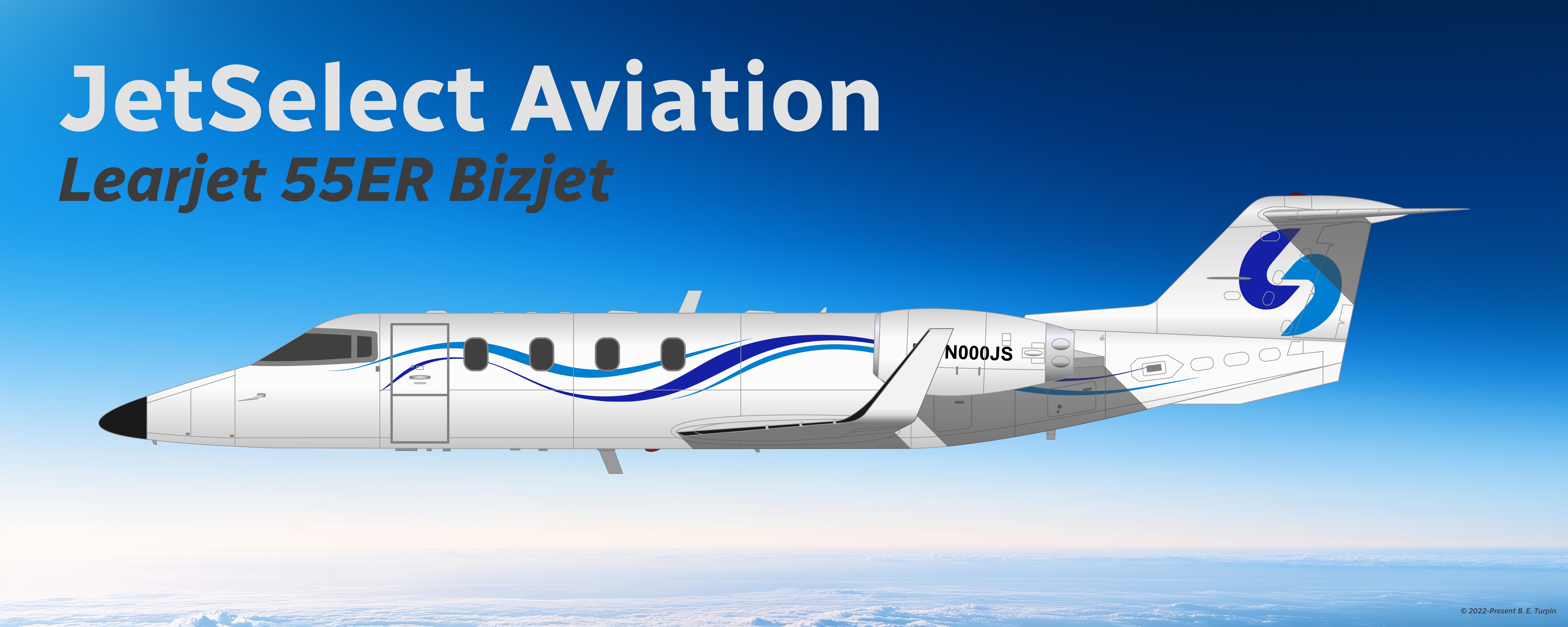
JStream Original Aircraft Template
The Learjet 55/60 series of aircraft are a series of midsized, medium-range twin engine business jets designed and manufactured by Learjet Corporation of Wichita, Kansas USA.
Learjet 55
The Learjet 55 was first announced at the 1977 Paris Air Show. It boasted a larger cabin than previous Learjet models, and was originally planned to be sold in three variants:
The Learjet 55, the baseline 10-seat variant;
The Learjet 54, a slightly extended fuselage edition seating 11 passengers; and
The Learjet 56, a shorter version seating 8 passengers.
Ultimately, only the Learjet 55 made it into production.
The Learjet 55 used winglets, which were derived from the commercially unsuccessful Learjet 28 and Learjet 29 models. Like most Learjet models of the time, the Learjet 55 was powered by two upgraded Garrett TFE731 (now Honeywell TFE731) turbofan jet engines mounted on each side of the rear fuselage. The type had a flight range of 2165 nautical miles (nmi) / 4010 km.
A total of 147 units of the Learjet 55 were produced between 1981 and 1987, after which it was superseded by the Learjet 60.
Reference: Wikipedia.
Learjet 60
The Learjet 60 was an improved and modernized version of the Learjet 55 that debuted in 1993. By then, Bombardier Aerospace had acquired the company and expedited its introduction.
Among many things, the Learjet 60 switched out the Garrett TFE731 engines in favor of more powerful Pratt & Whitney PW305A powerplants, making it the only production Learjet model to use them. The Learjet 60 also featured a longer fuselage with more cabin headroom, a Collins Pro Line 4 glass cockpit with more advanced avionics, ventral fins, various aerodynamic refinements, and a full width aft lavatory. The upgrades resulted in a more capable and comfortable jet that delivered faster time-to-climb, higher cruise speeds, and improved handling as compared with the Learjet 55. The flight range of the Learjet 60 was slightly better than the Lear 55, coming in at 2250 nmi / 4167 km.
Production of the baseline Learjet 60 ended in 2007 with 318 aircraft built. It was replaced by the Learjet 60XR subvariant. While it is considered by many to be an excellent midsized business jet overall, the Learjet 60 has a higher than average rate of pilot-error incidents and accidents.
Learjet 60XR
Bombardier launched the Learjet 60XR in 2005. After certification the type began deliveries in 2007, replacing the baseline Learjet 60 variant.
The Learjet 60XR is visually identical to the baseline Lear 60, but features several internal upgrades including a Rockwell Collins Pro Line 21 glass cockpit with larger displays and enhanced situational awareness features, a redesigned cabin with better noise insulation, an improved galley, ergonomic seating, LED lighting, digital steer-by-wire nose gear and upgraded brakes. The 60XR retained the PW205 engines of its base model, but its range extended to 2400 nmi / 4445 km, giving the aircraft a near-transcontinental flight range.
Production of the Learjet 60XR ran from 2007 to 2012 with a total of 112 units built. This ended production of the largest series of Learjets, while the somewhat smaller Learjet 70/75 series continued to be produced until 2022.
Legacy
At the time, the Learjet 60XR was to be superseded by the new generation Learjet 85. However, Bombardier decided to cancel the Learjet 85 program in 2015 to better concentrate on its forthcoming Bombardier CSeries airliner - now known as the Airbus A220 - and its larger, ultra long range Bombardier Global 7500/8000 business jet.
As of the mid 2020s, approximately 250-300 Learjet 60s are still in service, while about 90 Learjet 55s remain active.
Reference: Wikipedia.
Stats
Stats displayed are for the Learjet 60XR twinjet aircraft.
Name: Learjet 60XR
Final Assembly Line: Wichita, Kansas USA
Role: Large Twin Engine Medium Range Business Jet
First Introduction (Learjet 60XR): 7 September 2007
Status: Out of Production; In Service
Cockpit Crew: Two
Seating: Up to 9
Engines: 2 × Honeywell TFE731
Cruise Speed: 445 knots (804 km/h; 510 mph)
Range: 1710 nmi (3167 km; 1968 mi)