
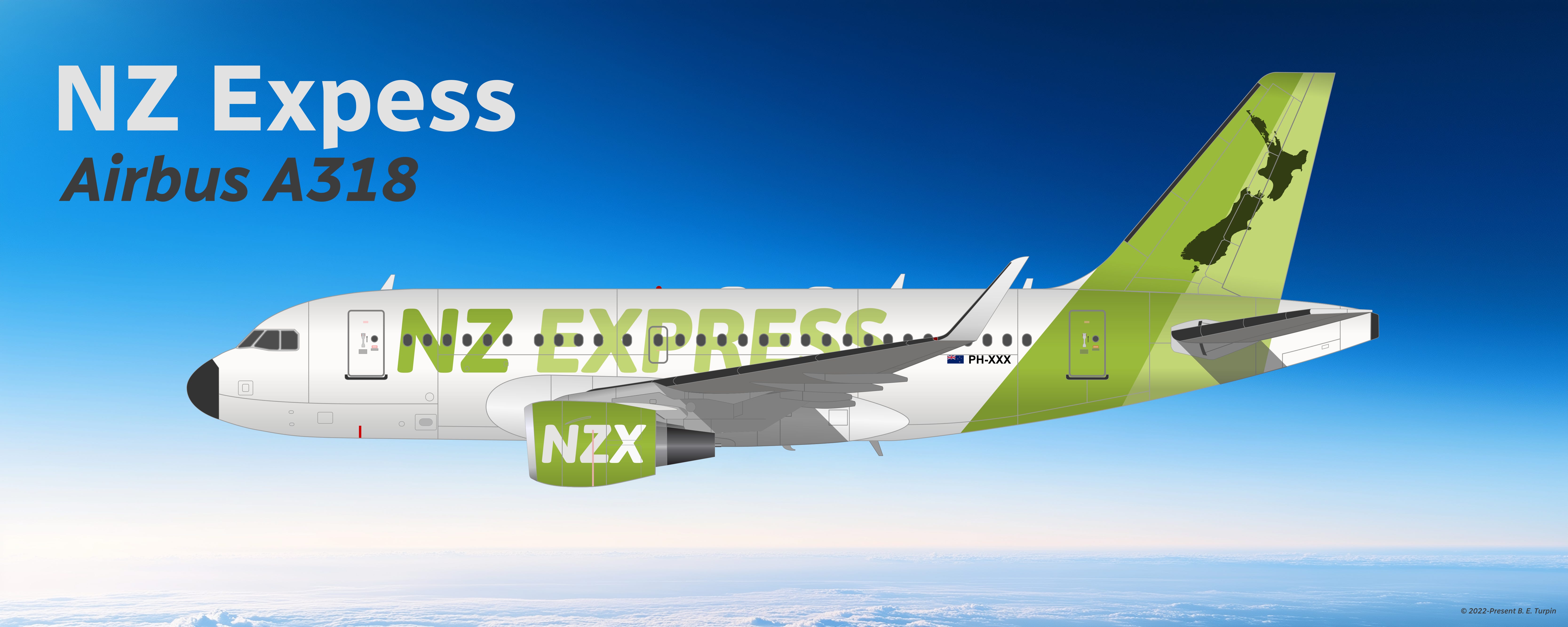
NZ Express - legally registered as NZ Express Airways, Ltd - is a New Zealand airline with head offices located at Christchurch-CHC, New Zealand. Its primary hub operations are located at Auckland-AKL and Wellington-WLG, also in New Zealand.
Founded in 1920 under the name South Island Airways, NZ Express was the result of a 1971 merger between South Island Airways and its primary competitor at the time, Hamilton-HLZ, New Zealand based Waikato Air.
NZ Express operates foremost as a regional airline, specializing in providing feeder services to smaller airports within New Zealand, but also operates a selection of routes to nearby Pacific island countries, and to Sydney-SYD, Melbourne-MEL, and Brisbane-BNE in Australia.
History
1920-1971: Pre Merger Era
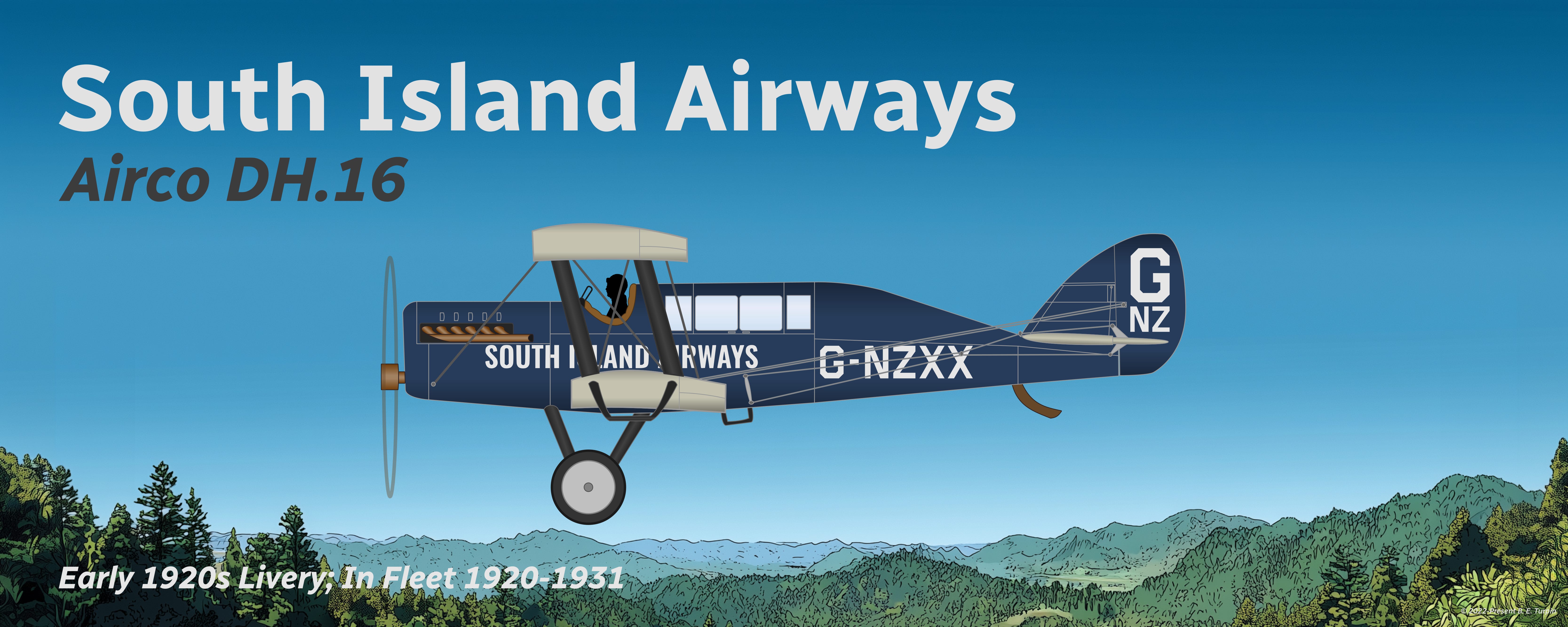
The airline now known as NZ Express has roots in two domestic airlines that were established in New Zealand during the early 1920s. They were:
South Island Airways, sometimes referred to by its initials SIA, which was the first airline established in New Zealand. Founded in 1920 at Christchurch, South Island, New Zealand, SIA used a single Avro 504K biplane for sightseeing purposes and a Airco DH.16 for scheduled flights, carrying up to 4 passengers and/or mail between Auckland-Kohimarama Bay«»Christchurch-Sockburn and Wellington«»Christchurch-Sockburn. SIA also provided mail transport for the New Zealand Post Office (NZPO).
Waikato Air was established in 1922 at Hamilton, North Island, New Zealand. It began as a mail delivery service using an Avro 504K biplane. They acquired their own Airco DH.16 in 1923. By the late 1920s the DH.16s were replaced with a pair of Ford Trimotor monoplanes that began scheduled air service to several towns around the North Island.
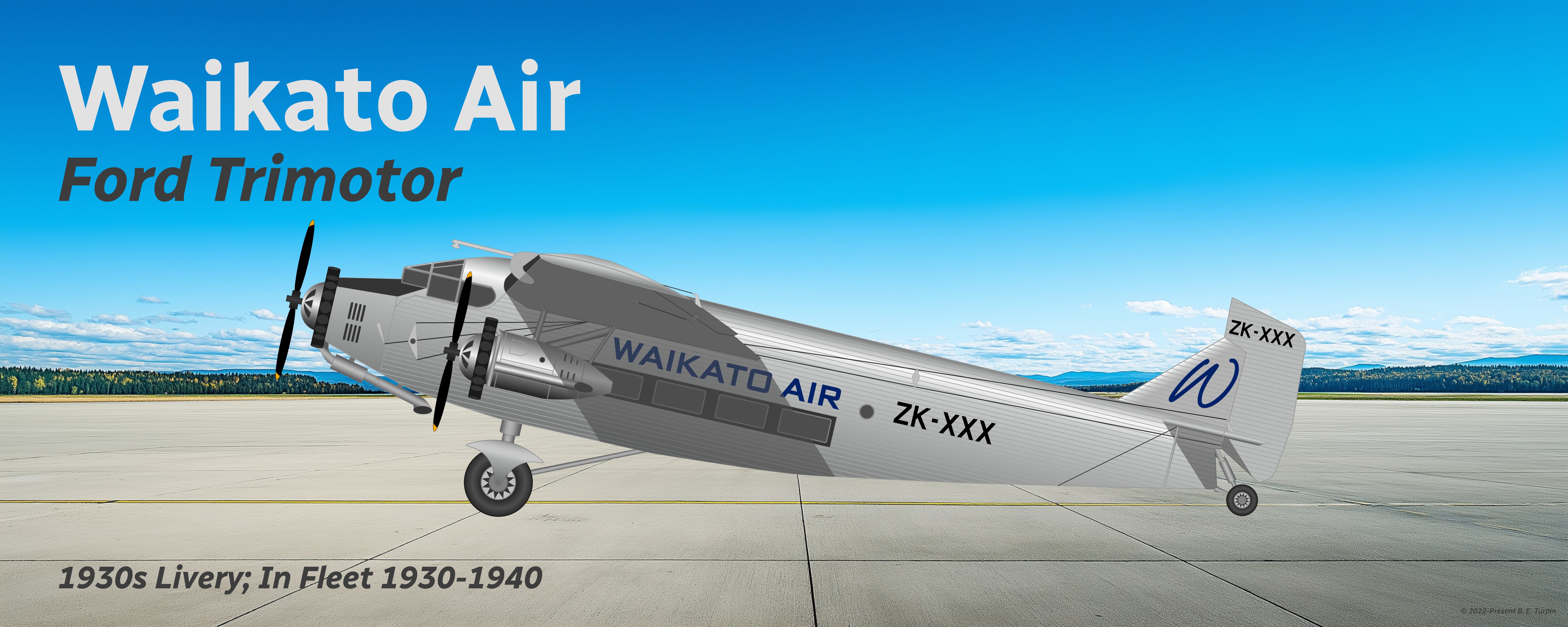
By the early 1930s South Island Airways and Waikato Air were the 1st and 2nd largest airlines in New Zealand, respectively. The two carriers emerged as the primary domestic airlines and airmail service providers for their respective island regions. Both carriers operated interisland flights between Auckland«»Christchurch and Wellington«»Christchurch on alternating days of the week, with no air service on Sundays.
World War II Years
In 1940, the New Zealand government seized control of all aircraft owned by South Island Airways and Waikato Air, to be repurposed for military use during World War II (WWII). Both carriers remained on the sidelines throughout the war, and virtually all of their employees either joined the Royal New Zealand Air Force or found themselves reassigned to work for the newly created Australia New Zealand Airways (ANZA), a provisional airline established by a treaty signed among Australia, New Zealand and the United Kingdom. ANZA was set up to handle passengers, mail, and cargo between the two countries for the remainder of the war.
Although ANZA was mainly responsible for service to and from Australia, the new carrier did operate daily scheduled service along a single domestic route using its fleet of commandeered Douglas DC-3s and Lockheed 10 Electras, namely Auckland-AKL«»Wellington-WLG«»Christchurch-CHC. All other scheduled air service within New Zealand was suspended, although ANZA sometimes delivered freight to other airports as requested by the NZ government.
While ANZA’s trans-Tasman fleet of Short Sunderland flying boats and Lockheed 18 Lodestars were repainted in the new ANZA livery, their expropriated Douglas DC-3s and Lockheed 10 Electras remained painted in the liveries of their original owners: South Island Airways and Waikato Air, respectively.
Postwar Years 1945-1971


After the war ended, four airlines formed the backbone New Zealand’s civil aviation industry. They were:
New Zealand Airline Corporation (NZAC), founded in 1934 to fly passengers and cargo between NZ and Australia - mainly on the Auckland-AKL«»Sydney-SYD route - resumed its prewar operations;
New Zealand World Airways (NZWA), established by the New Zealand government in late 1945 to take over ANZA’s scheduled trans-Pacific services, and to connect to international destinations in the South Pacific islands, Asia, Hawaii and California USA;
South Island Airways; and
Waikato Air.
The New Zealand government returned most of the Douglas DC-3s that were appropriated from South Island Airways, although a few were unfortunately lost during the war years. The government also donated several military surplus DC-3s and Douglas C-47 Dakotas to both South Island Airways and Waikato Air, and provided some funding to help the carriers restart scheduled air service within New Zealand.
By the early 1950s, South Island Airways and Waikato Air became firmly entrenched rivals operating throughout the country. Meanwhile, NZWA and NZAC became largely uncontested international carriers with full control of their own respective corridors: NZAC on the routes to and from Australia, and NZWA to the Pacific and the rest of the world.
While a few smaller commercial airlines would come and go throughout the Cold War years, South Island Airways and Waikato Air settled into a firm duopoly with overlapping routes. This of course resulted in higher airfares and rather limited regional competition.
1971 Merger: New Zealand Express


In 1971, the New Zealand Parliament formally ended the aforesaid postwar duopolies and opened all air routes to competition.
South Island Airways and Waikato Air were compelled to merge and form a single, privately owned carrier, named New Zealand Express Airways, which was usually known as NZ Express Airways for short. Meanwhile, NZWA and NZAC were forcibly merged into a single, government owned international airline to serve as the country’s flag carrier: New Zealand International (NZI).
This change did not particularly lower airfares in and of itself, but within a few years competitors did emerge, including Kiwiair, Tasman Air, and Aotearoa Airlines, along with a pair of feeder airlines operated by Australian carriers of the time.
Despite being well over a decade into the Jet Age, the 1971 merger left NZ Express Airways with an all propeller-driven fleet including the following aircraft:
During the early 1970s the DC-3s, F27s and HS 748s flew mostly among the Big Four cities - the larger New Zealand cities of Auckland-AKL, Christchurch-CHC, Queenstown-ZQC and Wellington-WLG - while the rest of the fleet served various smaller airfields across the country.
In 1972 the airline acquired its first jetliners: A set of 3 Fokker F28 Friendship regional jets, which initially serviced the Auckland-AKL«»Wellington-WLG and Auckland-AKL«»Christchurch-CHC routes. The company added a pair of McDonnell Douglas DC-9-10s to these same routes in 1975, while the F28s began to service other routes among the cities of Auckland-AKL, Wellington-WLG, Christchurch-CHC, Queenstown-ZQC and Dunedin-DUD.
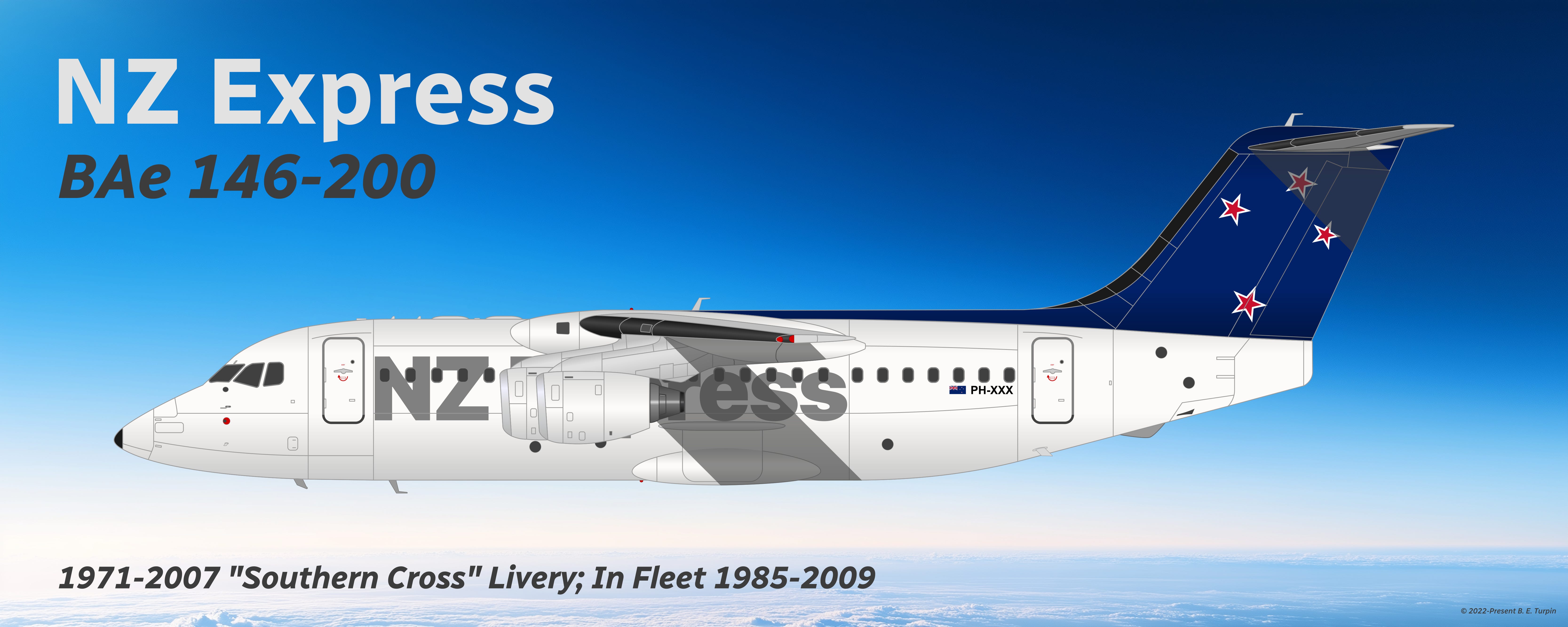
In 1981 New Zealand Express officially shortened its brand name to NZ Express. Later that same year NZ Express signed up to become an early customer of the British Aerospace (BAe) 146 quadjets, which were notable for its exceptionally quiet geared turbofan engines and ability to operate from rugged airfields.
The first BAe jets arrived in 1985 and began replacing the F28 Friendship jets. The new aircraft became the primary jet used on flights in and out of Wellington-WLG, whose airport is notorious for its shorter runway and difficult weather due to strong and gusty winds that can make landings turbulent.


In the early 1990s the carrier began importing ATR 42s and ATR 72s to use on its thinner domestic routes, and by 1996 NZ Express had retired all of its original prop fleet except for a few remaining de Havilland DHC-6 Twin Otters still connecting to a few smaller airfields. In 1997 the company added a pair of Pilatus PC-12s to handle charter flights to the most remote spots and to support niche markets such as movie filming and extreme sporting activities.


After substantial research, in 2007 NZ Express selected the Airbus A318 and Airbus A319 to replace its British Aerospace 146 fleet, the last of which were retired and donated to an airline in Kiribati (see “South Pacific Milk Run Route” below). The carrier also decided to use the occasion to replace its original 1971-era livery, introducing a new, two-tone green NZ Kiwi Livery, featuring an outline map of New Zealand on a green tail with the words “NZ EXPRESS” emblazoned in a more modern font across the fuselage. Over the next two years the company repainted the entire fleet in the new Kiwi livery as its aircraft were brought in for regularly scheduled maintenance.
Transition to Aria Aircraft-Based Fleet


During the 2021 Paris Air Show, NZ Express announced orders for several new generation Aria Aircraft, with plans to become an all-Aria fleet by 2028. Included were orders for several Aria T42 Transonic, Aria T72 Transonic, and Aria T102 Transonic airliners to replace the company’s Airbus A318 and A319 fleet by the late 2020s.
NZ Express also became the launch customer for the groundbreaking new Aria V42qc V/STOL Combi, a quieter ducted fan V/STOL aircraft equipped for quick conversions to passenger, freighter, or mixed configurations. The V42qc were set to replace the company’s fleet of Pilatus PC-12s and de Havilland DHC-6 Twin Otters, while increasing potential passenger loads per flight to domestic airports with otherwise constrained passenger capacities due to shorter runways.
NZ Express had previously ordered a set of Airbus A320neos in 2018, which were to be applied to the carrier’s busy New Zealand-to-Australia routes. However, in early 2022 NZ Express cancelled that order in favor of the Aria T152 Transonic and Aria T182 Transonic, which were to begin deliveries by 2026 or 2027.
In 2023 the carrier ordered more Aria T42s and Aria V42s with plans to retire the company’s remaining ATR42/72 fleet by 2028.
NZ Express took delivery of its first Aria aircraft, an Aria T42 Transonic, during the October 2023 Aria and Friends trade show event at Denver-DEN, Colorado USA. It was introduced into revenue service on 8 November 2023 on a flight servicing the Auckland-AKL«»Rarotonga-RAR routing.
The carrier’s first Aria T102 Transonic arrived a month later and entered service on 7 February 2024 on the Auckland-AKL«»Christchurch-CHC route.
Most recently the Aria V42hqc Hybrid V/STOL Combi was delivered in October 2025 and went into service on 12 November 2025, operating on a circuit connecting Wellington-WLG«»Mount Cook-MON«»Christchurch-CHC. Thereafter the company’s remaining A318 and A319 aircraft were reassigned to operate exclusively on routes to and from Australia.
International Route Expansion


From 1971 until 1988, NZ Express was an all-domestic airline that operated exclusively within New Zealand.
In 1988, flag carrier New Zealand International (NZI) decided to discontinue its twice weekly air service to Norfolk Island-NLK, Australia, and NZ Express applied for permission to take over the Auckland-AKL«»Norfolk Island-NLK route, seeking to offer thrice-weekly service using its recently acquired BAe 146 aircraft. The Australian and New Zealand governments granted the application, allowing NZ Express to take on its first international route.
In early 1989, the government-owned New Zealand International (NZI) made a bid to take over NZ Express as a subsidiary. This offer was rejected by NZ Express management, and when it became clear the New Zealand Parliament would not approve any sort of merger or takeover, NZI and NZ Express entered into negotiations to share some routes in the South Pacific.
The two carriers signed a cooperation agreement in December 1989, wherein NZI agreed to spin off some of its thinner international routes to NZ Express, share some of its maintenance assets at Auckland-AKL and Wellington-WLG, and to not operate domestic flights, in exchange for NZ Express refraining from adding service between New Zealand and Australia for the next 20 years.
So it was from the early 1990s onward that NZ Express began to take over certain former NZI routes to select Pacific island destinations, while allowing NZI and NZ Express to protect their most profitable routes.
NZ Express soon started flying its BAe 146s to nearby Pacific island countries, beginning with Auckland-AKL«»Port Vila-VLI, Vanuatu and Auckland-AKL«»Noumea-NOU, New Caledonia in 1990. Direct service between Auckland-AKL«»Niue-IUE, which was supported with funding by the New Zealand government, soon followed in 1993. Next NZI handed off Auckland-AKL«»Funafuti-FUN, Tuvalu in 1997, then Auckland-AKL«»Apia-APW, Samoa and Auckland-AKL«»Pago Pago, American Samoa in 1999.
In January 2000, NZI transferred its Auckland-AKL«»Tonga-TBU«»Kiritimati-CXI route over to NZ Express - just after NZI had benefited from very lucrative Millennium celebrations held on both islands, as they were the first places in the world to enter the new millennium on 1 January, 2000. NZ Express found the Tonga-TBU«»Kiritimati-CXI segment to be unprofitable, and ended service to Kiritimati-CXI in 2001.
Other NZI routes acquired by NZ Express with the arrival of the Airbus A318 included Auckland-AKL«»Honiara-HIR, Solomon Islands in 2007, followed by Auckland-AKL«»Rarotonga-RAR in the Cook Islands and and Auckland-AKL«»Nadi-NAN, Fiji in 2018. Most recently, service between Auckland-AKL«»Tahiti-PPT was transferred from NZI to NZ Express in 2023.
Route Expansion To Australia


The 20-year non-compete clause included in the NZI/NZ Express cooperation agreement expired on 31 December 2009.
The following day - 1 January 2010 - NZ Express promptly began offering nonstop trans-Tasman flight services to Australia, starting with Christchurch-CHC«»Sydney-SYD, Christchurch-CHC«»Melbourne-MEL, and Christchurch-CHC«»Brisbane-BNE. Service between Queenstown-ZQN and Brisbane-BNE, Melbourne-MEL, and Sydney-SYD were next added in 2012, followed by additional services these three Australian cities from Wellington-WLG beginning in 2014.
When NZ Express began to fly nonstop flights between Auckland-AKL and Brisbane-BNE, Melbourne-MEL, and Sydney-SYD in 2016, NZI responded by scheduling domestic flights of its own between Auckland-AKL, Wellington-WLG, and Christchurch-CHC. This triggered a series of airfare pricing wars between NZI and NZ Express wherever their routes overlapped each other, which resulted in increased passenger traffic but surprisingly did not significantly weaken NZ Express’ market share, although some 3rd party carriers did suffer a bit.
By the end of the 2010s, thanks in part to an eye-catching and humorous television ad campaign playing both in Australia and New Zealand, NZ Express managed to gain the upper hand on its routes to Australia, while still maintaining its dominance in the domestic market.
Covid 19 Pandemic
This winning strategy came to a halt in early 2020, however, when the Covid19 pandemic took hold in Australia and New Zealand.
The massive drop in air traffic brought on by Covid19, along with decisions made by the NZ government that tended to favor using NZI to deliver food, medicines and supplies from Australia, soon took its toll on NZ Express’ finances. By late 2020, mounting financial losses forced the company to exit the NZ-to-Australia market altogether in order to avoid taking bankruptcy.
In July 2022, however, it was discovered that NLI’s upper management and some government regulators colluded to force NZ Express into bankruptcy or push it out of the trans-Tasman market, to the benefit of NLI either way. The ensuing scandal forced the CEO of New Zealand International and three government officials to resign and face charges of corruption. The New Zealand government subsequently passed a new law formally banning NZI from operating domestic flights and requiring them to focus exclusively on international air services.
From early 2023, NZ Express gradually resumed its trans-Tasman air service, eventually returning to pre-Covid levels of service by 2025.
South Pacific Milk Run Route
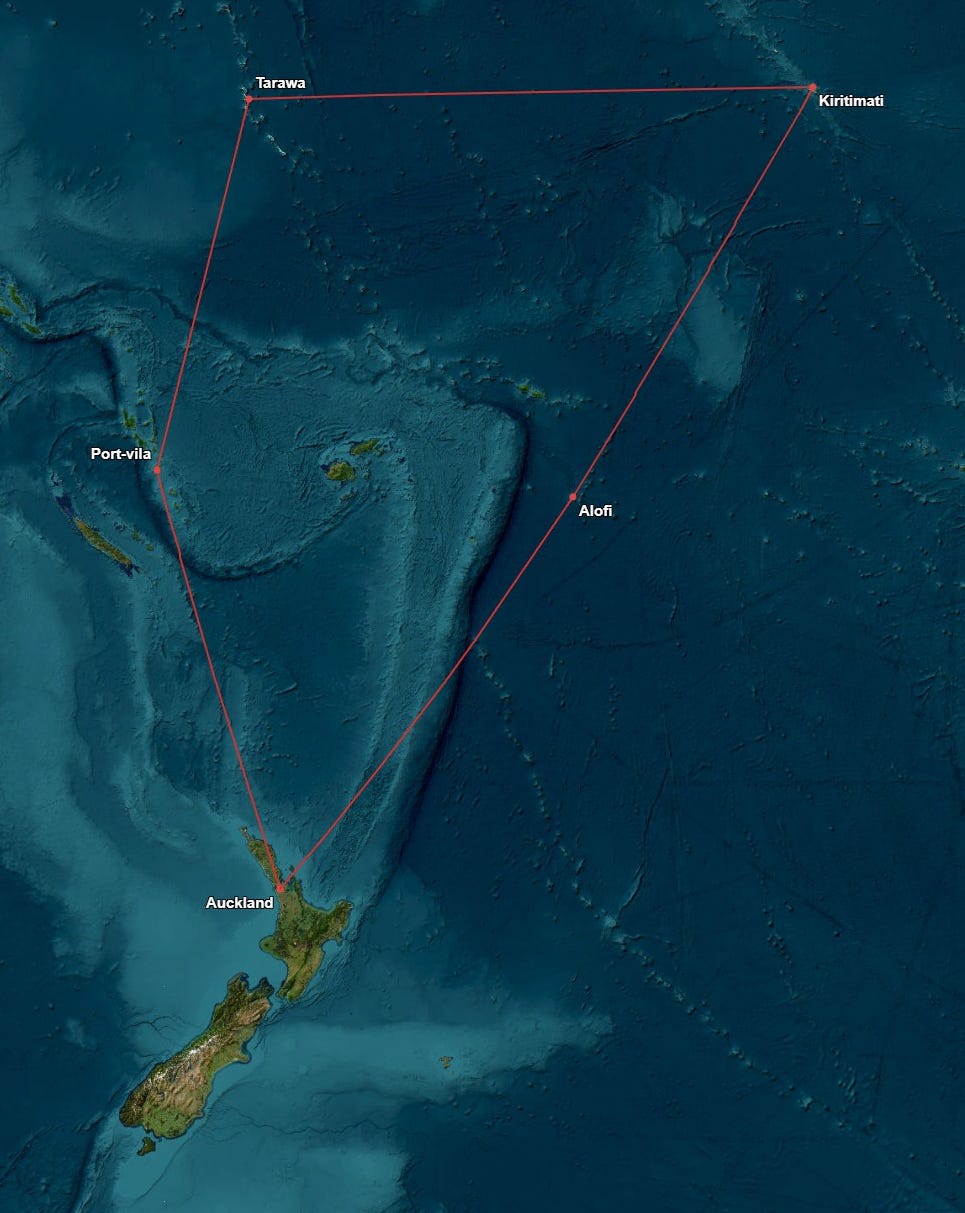
In 2008, the government of Kiribati reached out to NZ Express about the possibility of adding service to its airports at Tarawa-TRW and Kiritimati-CXI. The proposal included a domestic flight segment connecting Tarawa-TRW«»Kiritimati-CXI, creating a fixed circular route with multiple stops.
At the time, Kiribati’s own airline, Kiribati Airlines, had only turboprop aircraft and could not provide direct air service between Tarawa and Kiritimati. Another carrier, the Majuro, Marshall Islands-based Air Majel, had been contracted to operate the link between the two islands. However, Air Majel had recently announced plans to cancel all air service to Kiribati, so a new provider was desperately needed.
With a bit of encouragement from the New Zealand government, NZ Express agreed to set up a thrice-weekly milk run airline route using a pair of its British Aerospace Ae 146 jets to connect Auckland-AKL with Kiribati, with an outbound stop at Port-Vila-VLI in Tuvalu and a return layover at Niue-IUE, like so:
Auckland-AKL«»Port Vila-VLI«»Tarawa-TRW«»Kiritimati-CXI«»Niue-IUE«»Auckland-AKL
The Kiribati Milk Run service began in August 2008, with partial funding provided by the New Zealand and Kiribati governments.
By 2011, NZ Express had completed its migration to the Airbus A318 and A319, and donated its last two BAe 146 aircraft to Kiribati Airlines, who took over the Tarawa-TRW«»Kiritimati-CXI segment of the route while NZ Express continued to provide thrice-weekly direct service between Auckland-AKL«»Tarawa-TRW and Auckland-AKL«»Kiritimati-CXI, using its new Airbus A318s.
In 2012, the Kiribati government received a generous grant of funding from the governments of the United States, Australia, and New Zealand to facilitate the modernization of the Kiribati Airlines fleet as well as its key airports. The funding allowed Kiribati to lease newer generation aircraft, beginning in 2014 with the Embraer 190. In 2019 Kiribati upgraded its lease to Airbus A220-100s, after which NZ Express decided to end its Auckland-AKL«»Tarawa-TRW and Auckland-AKL«»Kiritimati-CXI routes, allowing Kiribati Airlines to fly the routes at a fair profit. Kiribati Airlines was also given access to NZ Express gates at AKL, an arrangement that still remains in effect to this day.
Current Status and Future Plans


In early 2026, Aria Aircraft began making deliveries of its Aria T152 Transonic and Aria T182 Transonic narrowbody airliners. Both types operate primarily on routes to and from Australia in place of the Airbus A318 and Airbus A319ceo. The carrier plans to remove its last A318s from South Pacific routes such as Auckland-AKL«»Nadi-NAN and Auckland-AKL«»Tahiti-PPT, which are now to be covered by Aria T102 Transonic T-tail jets.
Meanwhile Aria T42 Transonic and Aria T72 Transonic jets also cover Pacific destinations, and the T42, T72 and T102 jets now operate on most of NZ Express’ domestic routes. The new Aria V42hqc Hybrid V/STOL has been phased in to handle the smallest airfields on the company route network, replacing the carrier’s remaining ATR 42 and ATR 72 turboprop fleet. The last Pilatus PC-12 was retired from the NZ Express fleet in late 2025, ending its niche charter services.
Overall, NZ Express remains the primary carrier of choice in New Zealand for domestic and near-Pacific flights, although its chief competitor Kiwiair competes effectively in several domestic markets as a low cost carrier (LCC), and Aotearoa Airlines has done well competing in the Auckland-AKL and Wellington-WLG markets. Although it is not the sole carrier at Christchurch-CHC, NZ Express remains somewhat dominant in its hometown, where it has a strong focus city operation in play.
NZ Express continues to compete well on trans-Tasman routes against New Zealand International (NZI) and other competitors. The airline is continuing to refresh its fleet and expects to have an all-Aria by 2027, roughly one year ahead of schedule.
Despite NZ Express’ past battles with NZI over the trans-Tasman market, the two airlines recently signed a new cooperation agreement that arranges for NZ Express to take over service between Auckland-AKL«»Port Moresby-POM, New Guinea. Meanwhile, NZ Express is looking to add an uncontested route to Auckland-AKL-Adelaide-ADL by mid 2026, as well as new service between Auckland-AKL«»Gold Coast-OOL and Christchurch-CHC«»Gold Coast-OOL by late 2026 or early 2027.
Destinations
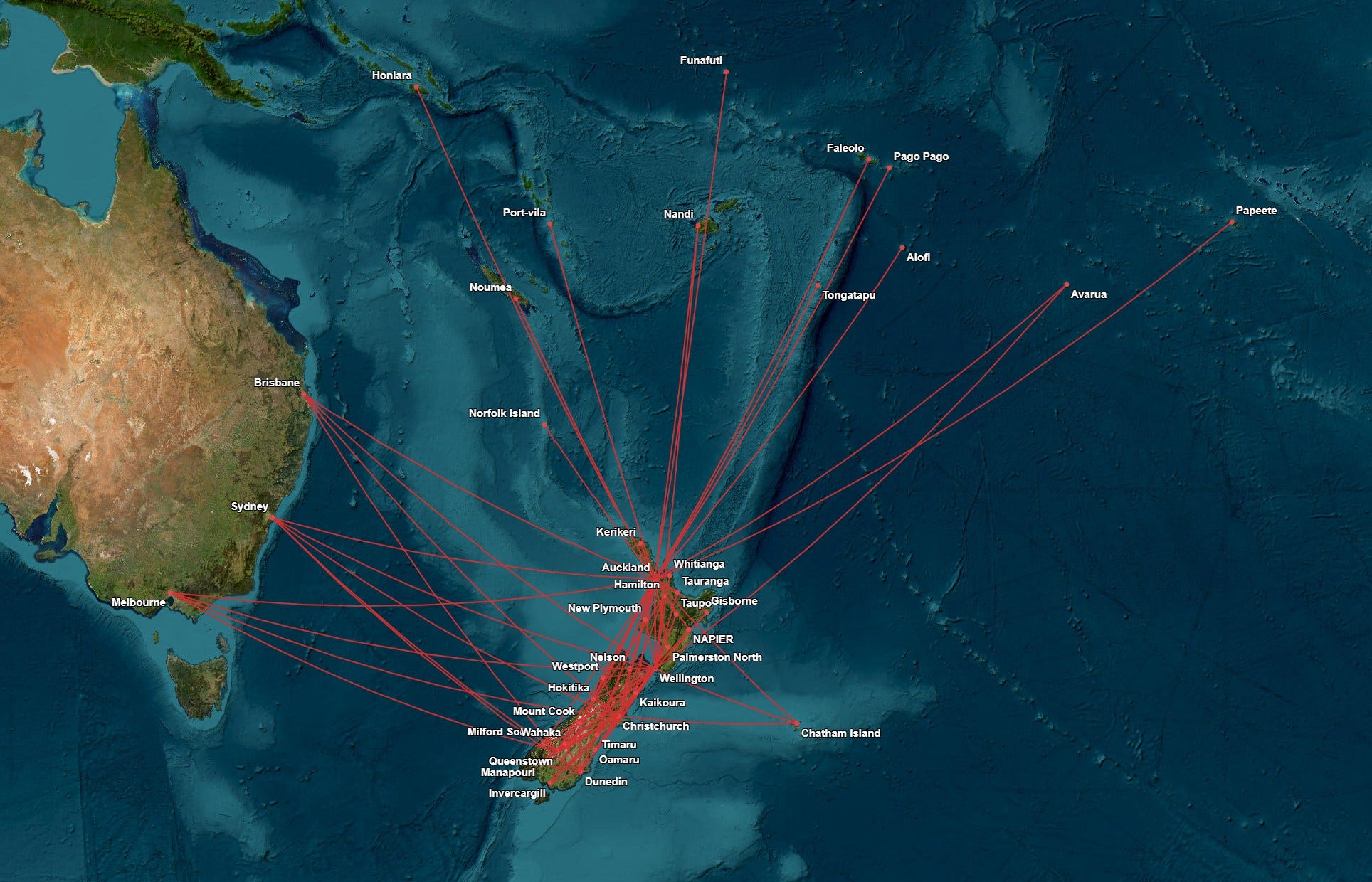
[ NZ Express System Route Map ]
Domestic Destinations
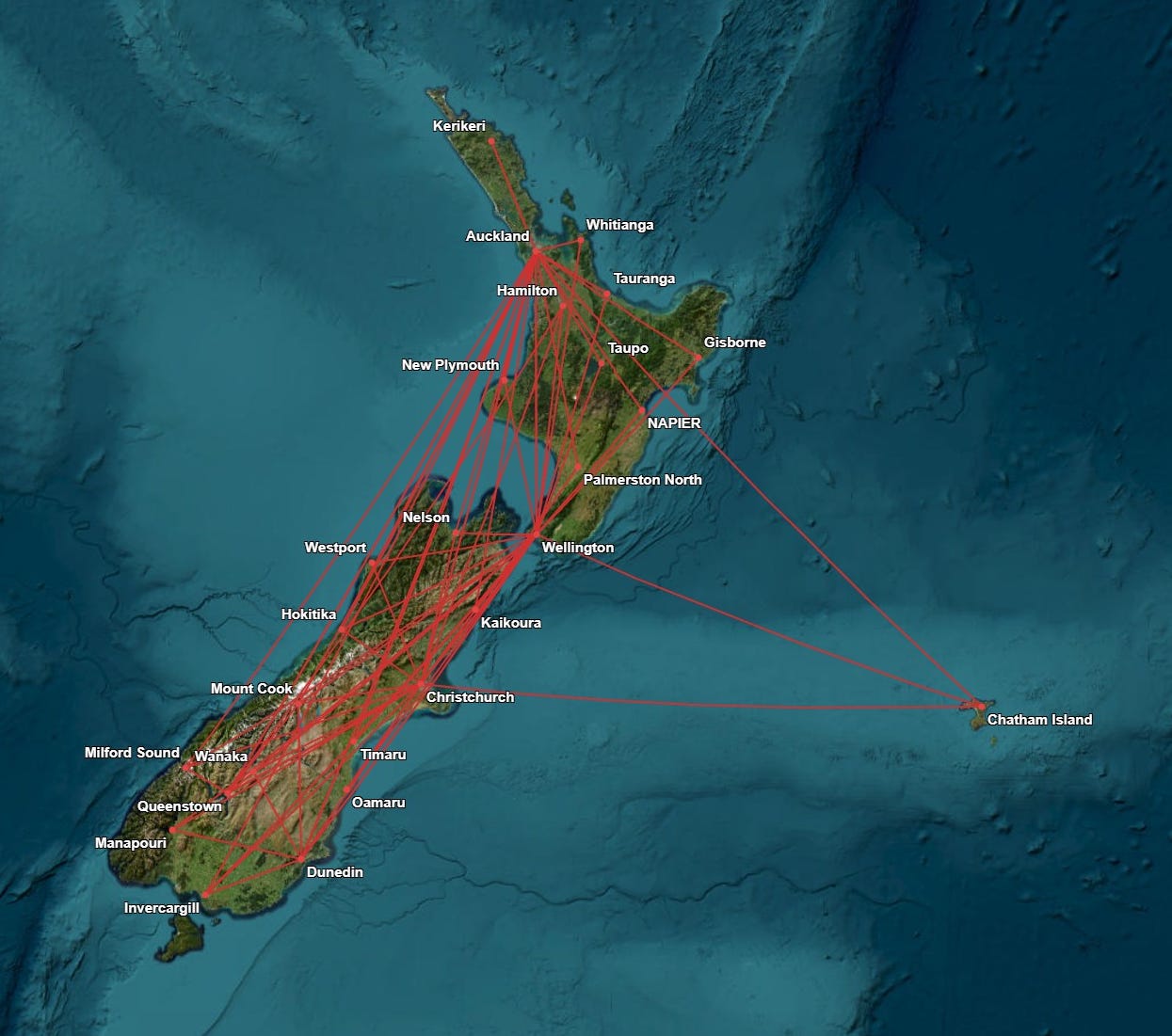
NZ Express currently serves the following destinations within New Zealand:
Auckland-AKL, New Zealand - Hub
Wellington-WLG, New Zealand - Hub
Christchurch-CHC, New Zealand - HQ/Focus City
Dunedin-DUD, New Zealand - Focus City
Queenstown-ZQN, New Zealand - Focus City
Chatham Island-CHT, NZ
Gisborne-GIS, NZ
Hamilton-HLZ, NZ
Hokitika-HKK, NZ
Invercargill-IVC, NZ
Kaikoura-KBZ, NZ
Kerikeri-KKE, NZ
Milford Sound-MFN, NZ
Mount Cook Village-MON, NZ
Napier-NPL, NZ
Nelson-NSN, NZ
New Plymouth-NPL, NZ
Oamaru-OAM, NZ
Palmerston North-PMR, NZ
Taupo-TUO, NZ
Tauranga-TRG, NZ
Te Anau/Manapouri-TEU, NZ
Timaru-TIU, NZ
Wanaka-WKA, NZ
Westport-WSZ, NZ
Whitianga-WTZ, NZ
International Destinations
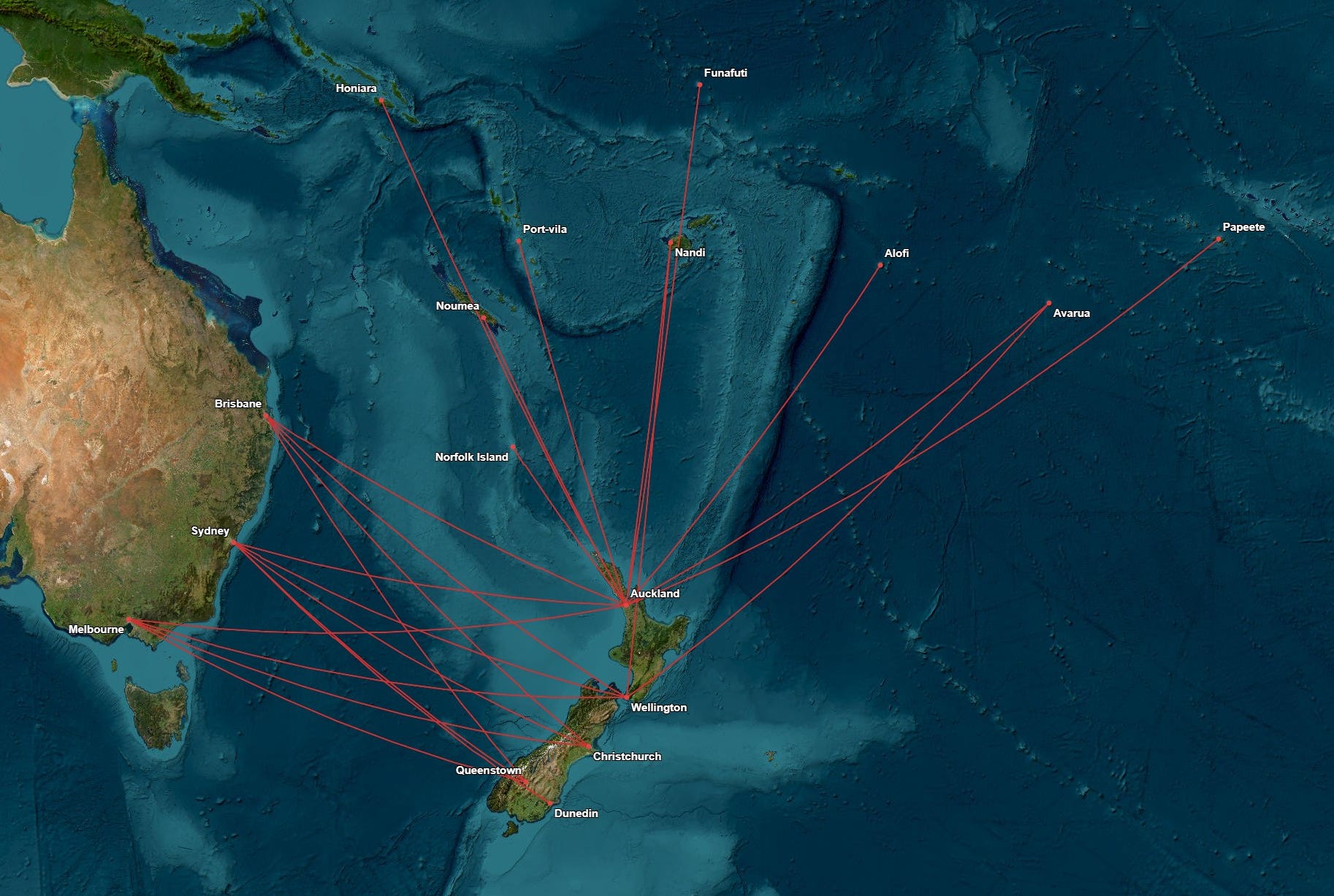
NZ Express currently serves the following international destinations in Australia and the South Pacific:
Apia-APW, Samoa
Brisbane-BNE, Australia
Funafuti-FUN, Tuvalu
Honiara-HIR, Solomon Islands
Melbourne-MEL, Australia
Nadi-NAN, Fiji
Niue-IUE, Niue
Norfolk Island-NLK, Australia
Noumea-NOU, New Caledonia
Pago Pago-PPG, American Samoa
Port Vila-VLI, Vanuatu
Rarotonga-RAR, Cook Islands
Sydney-SYD, Australia
Tahiti-PPT, French Polynesia
Tonga-TBU, Tonga
Fleet Maintenance Base
NZ Express currently operates maintenance bases at the following locations:
Christchurch-CHC, NZ - Primary Maintenance Base
Auckland-AKL, NZ - Secondary Maintenance Base (jointly held with NZI)
Fleet
NOTE: A dagger symbol † indicates availability of a JStream original aircraft template for the specified aircraft type.
Current Fleet


NZ Express currently operates the following aircraft.
Airbus A318 - since 2007 - departing by 2027 †
Airbus A319 - since 2009 - departing by 2027 †
Aria T42 Transonic - since 2023 †
Aria T72 Transonic - since 2024 †
Aria T102 Transonic - since 2024 †
Aria T152 Transonic - since 2026 †
Aria T182 Transonic - since 2026 †
Aria V42qc V/STOL Quick Combi - since 2025 †
ATR 42 - since 1990 - departing by 2027 †
ATR 72 - since 1992 - departing by 2027 †


Former Fleet
NZ Express and its predecessor companies previously operated the following aircraft, listed below in three groups:
Aircraft formerly used by South Island Airways;
Aircraft formerly used by Waikato Air; and
Aircraft formerly used by NZ Express after the 1971 merger.
Former fleet aircraft used by South Island Airways 1920-1971 include:
Avro 504K Biplane 1920-1933
Airco DH.16 1920-1931 †
Lockheed Vega 1930-1940
Fokker F.VII 1930-1940
Armstrong Whitworth Argosy 1930-1940
de Havilland DH.86 Express 1935-1940
de Havilland DH.89 Dragon Rapide 1935-1940
Douglas DC-3/C-47 Dakota 1938-1971 †
de Havilland Dove 1947-1952
Avro Tudor 1947-1952
de Havilland Heron 1947-1963
de Havilland Australia DHA-3 Drover 1949-1971 †
Vickers Viscount 1955-1971 †
de Havilland DHC-3 Otter 1960-1971 †
Handley Page Dart Herald 1963-1966
Hawker Siddeley HS 748 1964-1971
de Havilland DHC-6 Twin Otter 1969-1971 †
Britten-Norman BN2 Islander 1970-1971 †
Former fleet aircraft used by Waikato Air 1922-1971 include:
Avro 504K Biplane 1922-1930
Airco DH.16 1920-1934 †
Lockheed Vega 1930-1940
Ford Trimotor 1930-1940 †
Fokker F.XII 1932-1940
Junkers Ju 52 1934-1940
Vultee V-1 1936-1940
Lockheed 10 Electra 1937-1940
Handley Page Hermes 1946-1957
de Havilland Dove 1946-1952
Douglas DC-3/C-47 Dakota 1947-1971 †
de Havilland Heron 1947-1967
Vickers Viscount 1955-1967 †
de Havilland DHC-3 Otter 1960-1971 †
Fokker F27 Friendship 1963-1971 †
Britten-Norman BN2 Islander 1970-1971 †
Former fleet aircraft used by NZ Express after the 1971 Merger:
Britten-Norman BN2 Islander 1971-1992 †
de Havilland DHC-3 Otter 1971-1988 †
de Havilland DHC-6 Twin Otter 1971-2025 †
Douglas DC-3/C-47 Dakota 1971-1990 †
Fokker F27 Friendship 1971-1990 †
Fokker F28 Fellowship 1972-1986 †
Hawker Siddeley HS 748 1971-1996 †
McDonnell Douglas DC-9-10 1975-1986 †
British Aerospace BAe 146-100 1985-2009 †
British Aerospace BAe 146-200 1985-2011 †
Pilatus PC-12 1997-2025 †


=Nota Bene=
First off… having taken almost a year off from writing articles about fictitious airlines to concentrate on illustrating more aircraft, I’m back! It took a couple of weeks for me to get back into the rhythm of writing these stories, but I eventually managed to ramp up.
On the other hand, damn I wrote another loooong article! Sorry to anyone who might be offended by that for some reason. NZ Express was originally going to be a carrier of recent vintage, but after reading about the history of New Zealand’s airline industry I decided I had to go deeper, so I did. ¯\_(ツ)_/¯
That said, I decided not to dwell too much on the two carriers predating NZ Express, in favor of emphasizing the airline’s post-1971 merger history. This is why all of the current fleet aircraft are illustrated, but only a selection of the former fleet. Such a long-lived airline will have lots of historical aircraft in its past; after sketching out the company’s fleet history, I came up with 20 historical aircraft for South Island Airways, 16 for Waikato Air, and 10 more for NZ Express itself from 1971 to 1990. Illustrating all of those lovely vintage aircraft will take lots of time, which I’ll try to do in the course of things.
NZ Express itself is not based on any one specific real-life airline. I suppose Mount Cook Airline, which operated 1920-2019, might be the closest thing to it. (BTW that’s not a typo: The airline was officially branded as Mount Cook Airline, not Mount Cook Airlines.) Mount Cook did all sorts of interesting things during its existence - like fly adventurers onto glaciers, agricultural work, rescue missions, etc. Other than mentioning their early years as a sightseeing company in passing, I wanted to emphasize its actual airline aspects, which IRL Mount Cook didn’t really specialize in doing until 1961.
IRL South Island Airways was a small NZ carrier that operated 1952-1956 using a preloved de Havilland Dragon Rapide biplane acquired from the Royal New Zealand Air Force. I liked their name so I poached it. Waikato Air was an entirely fictional name I chose randomly. I placed the airline at Hamilton, New Zealand, the country’s 4th largest city, strictly for storytelling purposes, but also in part because the Kiwi rock band Split Enz hails from there so why not? 😁
Yes, NZ International was inspired by Air New Zealand, which is obviously the biggest fish in the New Zealand pond. NZ International probably deserves an article of its own someday, but that’ll have to wait for a while.
Researching the history of New Zealand’s airline industry served as a blunt reminder that I still have numerous vintage airliners I need to illustrate. Among ones I want to draw are the Lockheed Vega, Vultee V-1, Junkers Ju 52, Lockheed 10 Electra, de Havilland Dove and de Havilland Heron.
On the other hand, I did draw the aircraft templates for the following aircraft especially for this article: 1) British Aerospace BAe 146; 3) Hawker Siddeley HS 748; and 3) Airco DH.16.
Illustrating the British Aerospace BAe 146 wasn’t too painful, despite it being a quadjet with a high-mounted wing configuration. Researching the background story of the BAe 146 gave me a deeper appreciation for its mission flexibility and its ability to operate from rugged and/or difficult to access airfields. It’s a shame BAe wound up canceling its planned successor for the BAe 146, the Avro RJX, following the 9/11 attacks.
Drawing the Hawker Siddeley HS 748 was also somewhat straightforward, although its engines and landing gear presented their share of challenges. Then again, illustrating landing gear on most planes tends to be time consuming, and drawing the engines and propellers on prop planes always requires more effort than drawing jet engines. So I guess it was business as usual w/ the HS 748 in most aspects.
Drawing the Airco DH.16, OTOH, was definitely not a simple task! First off, the DH.16 - which was designed by none other than Geoffrey de Havilland, who soon started up his own aircraft company after completing the DH.16 project.
First off, the DH.16 was my first biplane, which feature struts and wiring to bind the upper wing to the lower wing, while most monoplanes are simply fastened to a wingbox on the fuselage. So, lots of crisscrossing wires!
For another - as was the case with the Ford Trimotor I drew back in May 2025 - the DH.16 relied heavily on external cables to manipulate the various flight control surfaces - so more wires! Plus, there were NO color photos of the DH.16; in real life they were all scrapped by the mid 1920s, before color photography had gained any real footing. Almost as bad was the grungy and/or ill-focused quality of what few b/w photos exist of the DH.16! The only reason I could draw the DH.16 at all was because I came across some blueprint drawings of it, which allowed me to figure it out.
In any event… I suspect the DH.16 will now be the oldest airliner aircraft I’ll ever get to illustrate. Although I thought the same thing about the Ford Trimotor, it was much easier to illustrate the Trimotor because there is a plentitude of photographic and blueprint documentation for it, along with several examples on static display, and several airworthy Trimotors are still flying around at airshows and whatnot. The DH.16 never got that kind of love it seems, which is a pity.
All liveries depicted in this article were conceived and drawn by the Author.
All Aria aircraft templates displayed in this article are fictional aircraft, whose original templates were drawn by the Author. (See also the complete list of Aria Aircraft templates.)
All other aircraft templates depicted in this article are original, in-house made content created by the Author. (See the complete list of JStream original aircraft templates.)
Route Maps used in this article were created using Great Circle Map.